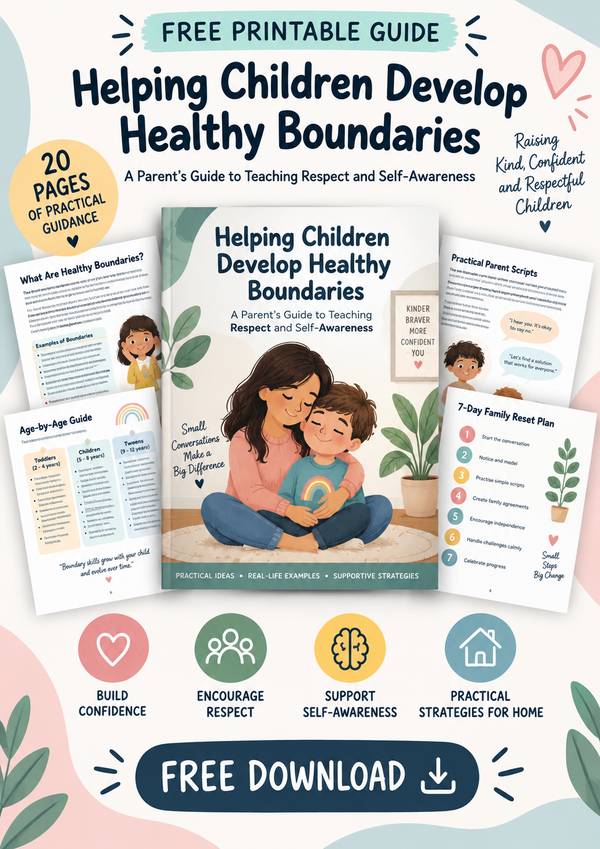
Helping Children Develop Healthy Boundaries: A Parent’s Guide to Teaching Respect and Self-Awareness
🔒 Secure checkout · Instant download
Description
Help your child build confidence, self-respect, empathy, and healthier relationships with practical boundary skills they can use every day.
Children are constantly learning how to interact with the people and world around them. They are discovering when to speak up, how to say no, how to respect another person’s space, how to manage uncomfortable feelings, and how to recognise when something simply does not feel right.
Helping Children Develop Healthy Boundaries: A Parent’s Guide to Teaching Respect and Self-Awareness gives parents and caregivers a clear, supportive way to teach these important life skills without making the subject complicated or frightening.
Healthy boundaries are not about creating distance between people. They help children understand that they can care about others while still having their own needs, feelings, preferences, personal space, and limits. At the same time, children learn that other people have boundaries too.
This practical guide explores how everyday family moments can become opportunities to develop stronger communication, emotional awareness, independence, and mutual respect.
Rather than relying on lectures or rigid rules, the guide focuses on simple conversations, calm repetition, age-appropriate examples, and practical strategies that families can use at home.
Inside the Guide You’ll Discover:
- What healthy boundaries are and why they matter during childhood
- How to teach children about personal space, privacy, feelings, possessions, time, and communication
- Age-appropriate ways to introduce boundary concepts
- How to help children recognise their own comfort levels and emotions
- Respectful ways children can say “no,” “stop,” or “I don’t like that”
- How to teach children to listen when somebody else sets a boundary
- Practical scripts parents can use during difficult everyday situations
- Ways to handle sibling disagreements, friendships, sharing, affection, and family expectations
- The difference between healthy boundaries and controlling behaviour
- Strategies for modelling respectful boundaries as a parent
- How to respond when a child’s boundary is ignored
- Guidance for discussing body autonomy and personal safety in an age-appropriate way
- Activities and exercises designed to strengthen self-awareness
- A simple family boundary agreement
- A practical 7-day plan for introducing healthier boundary habits at home
The guide also helps parents understand an important principle: children learn boundaries by experiencing them.
When adults listen to reasonable limits, apologise when necessary, avoid forced affection, communicate expectations clearly, and respect privacy appropriately, children see what healthy relationships look like in practice.
At the same time, healthy boundaries do not mean children control every family decision. Parents still provide structure, guidance, safety rules, responsibilities, and limits. The goal is to combine appropriate parental leadership with growing respect for the child’s developing independence.
Whether your child is just beginning to understand personal space or is navigating increasingly complicated friendships and social situations, this guide offers practical ideas that can grow with your family.
Give your child more than a set of rules. Help them develop the confidence to understand themselves, respect others, communicate clearly, and build healthier relationships throughout life.
Reviews
No reviews yet. Be the first to leave one.